 NL
NL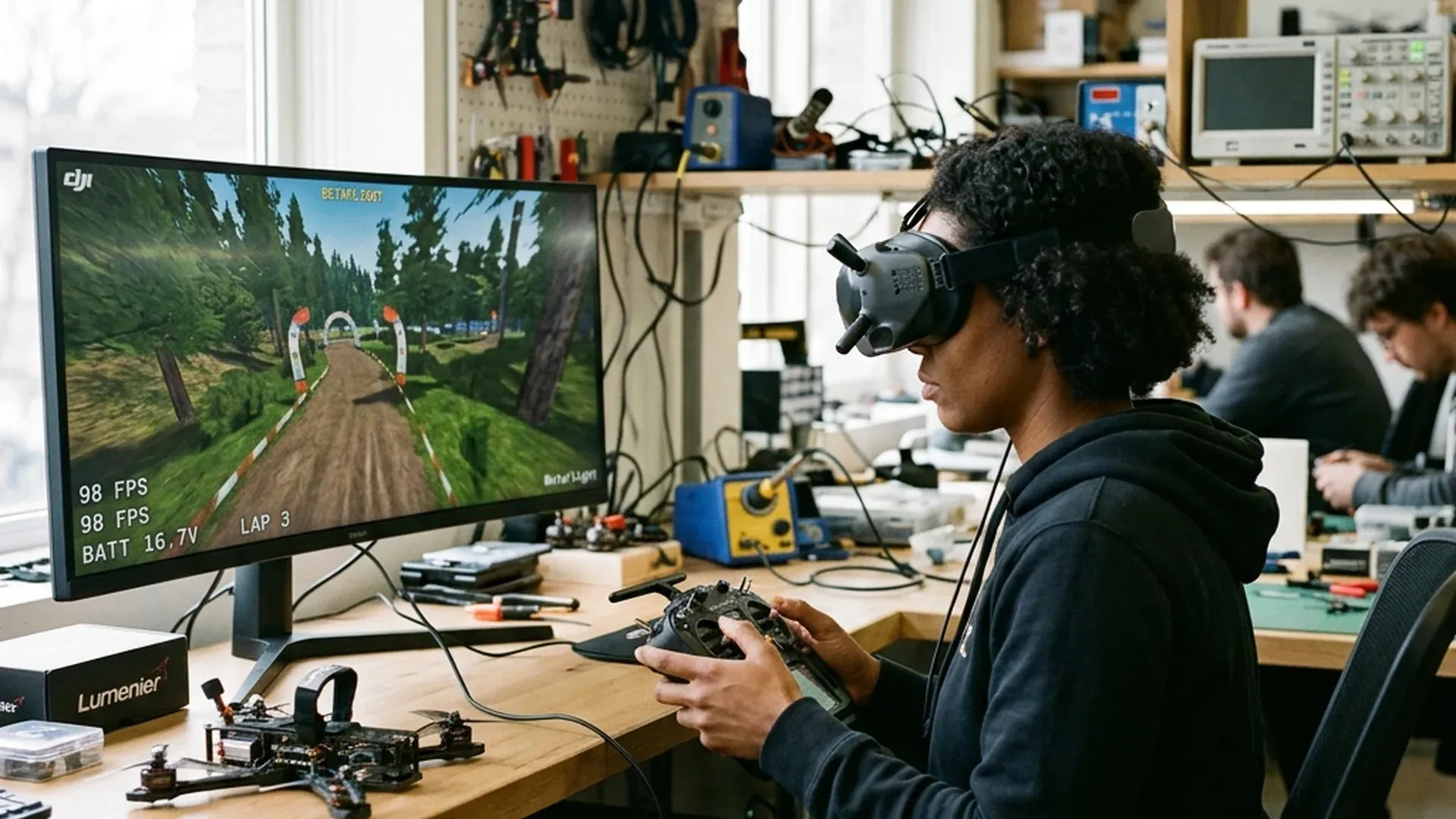
In the rapidly evolving world of First-Person View (FPV) drones, filmmakers and commercial operators are capturing visual sequences that were previously deemed physically impossible. From tracking high-speed race cars on racetracks to smoothly navigating narrow industrial facilities or capturing sweeping cinematic shots for feature films, the visual impact of FPV is unmatched. However, behind these breathtaking action shots lies a significant operational challenge: the margin for human error is virtually zero.
Unlike traditional GPS-assisted camera drones manufactured by companies like DJI, which automatically hover in place when the pilot releases the control sticks, professional FPV drones operate in full manual mode (Acro Mode). Without automatic altitude hold or obstacle avoidance, the pilot remains 100% responsible for every microsecond of flight. To minimize risk on set and protect expensive camera equipment and surrounding assets, digital simulator training has become an essential prerequisite for professional pilot certification.
The Anatomy of Acro Mode and the Necessity of Muscle Memory
When a pilot flies in Acro Mode, the control sticks on the radio transmitter do not dictate the drone's physical position or angle, but rather its rotational velocity around three axes: roll, pitch, and yaw. Pushing the pitch stick forward causes the drone to tilt continuously until a counter-steering input is applied. Maintaining steady speed and altitude requires constant, simultaneous micro-adjustments with both thumbs or fingers.
When an FPV cinewhoop flies through a narrow doorway at 60 kilometers per hour during an indoor FPV fly-through, there is simply no time for conscious deliberation over control inputs. The required reaction time is under 50 milliseconds. This degree of precision can only be achieved when control inputs are deeply ingrained in the motor cortex (muscle memory). A digital flight simulator provides the ideal, risk-free environment to develop this instinctual control.
How Modern FPV Simulators Match Real-World Physics
Early flight simulators were basic, arcade-style software, but modern FPV simulators function as advanced physics engines. Software platforms like Liftoff, VelociDrone, and Uncrashed replicate physical mass, center of gravity, prop wash, aerodynamic drag, gravitational acceleration, and turbulent wind conditions with incredible accuracy.
Furthermore, pilots connect their actual professional radio controllers (such as the TBS Tango 2 or RadioMaster Boxer) via USB directly to the PC. This ensures that the tactile feeling—including stick length, spring tension, and gimbal resistance—is identical to live flight. Pilots can log hundreds of crash scenarios in the virtual environment without incurring a single cent in physical damage.
Comparison: Virtual Simulator Training vs. Live Field Flight
To evaluate the impact of digital simulators on operational risk reduction, the table below highlights key differences between virtual simulation and real-world field operations:
| Operational Factor | Digital FPV Simulator | Real-World Field Flight |
|---|---|---|
| Financial Risk per Crash | € 0 (Instant reset with a single button press) | € 500 to € 4,000 in equipment damage per incident |
| Safety to Bystanders & Assets | 100% guaranteed zero risk | Requires strict EASA SORA risk assessments and exclusions |
| Training Density | 50 to 100 flights logged per hour | Constrained by battery swaps, charging, and setup |
| Weather Dependence | None (24/7 availability across all seasons) | Dependent on wind, rain, visibility, and temperature |
| Maneuver Complexity Testing | Unlimited testing of extreme flight paths | Execution restricted to pre-validated maneuvers |
Risk Mitigation Under EASA Regulations and SORA Frameworks
Under the European aviation framework managed by the European Union Aviation Safety Agency (EASA), commercial operators in the 'Specific' category must prove that operational risks are mitigated to acceptable safety thresholds. For complex flight operations near structures, crowds, or during action and motorsport productions, a documented simulator training program forms a core requirement of the Operations Manual (OM).
By demonstrating that a pilot has accumulated 50 to 100+ verified simulator hours tailored to specific drone airframes or flight corridors, flight operations managers can prove a reduced likelihood of pilot error. This accelerates operational authorization approvals from national aviation authorities and minimizes costly delays during commercial film shoots.
From Simulator to Set: The Hybrid Flight Training Method
While simulators establish an exceptional foundation for muscle memory, virtual environments cannot completely replace real-world experience. Factors such as video signal interference (VTX dropouts), depth perception through FPV goggles, and the psychological pressure of flying near high-value film cameras can only be mastered in live flight.
Professional drone teams therefore utilize a hybrid training methodology. After perfecting a flight line in the simulator, pilots transition to a lightweight, guarded FPV drone (such as a duct-protected cinewhoop) on a dedicated test field. Only when the flight path is executed flawlessly in real-world conditions is the maneuver transferred to heavier cinema platforms like professional cinema drones equipped with RED or ARRI cinema payloads.
The Future of Professional FPV Training in European Aviation
Integrating digital simulators into commercial drone pilot training has elevated safety standards across the European aviation ecosystem. By building instinctual muscle memory in a risk-free virtual environment, pilots operate faster, with greater precision, and above all, with enhanced safety in the field. For production companies, industrial clients, and event organizers, this methodology ensures that complex FPV sequences are captured with maximum control and minimal operational risk.
Frequently Asked Questions About FPV Simulators and Drone Training
How many simulator hours should an FPV pilot log before their first real flight?
A minimum of 20 to 30 simulator hours is recommended for beginners to establish basic Acro Mode control and muscle memory. Commercial cinema and indoor FPV pilots typically log hundreds of hours of ongoing simulator practice.
Can I use a standard gaming controller (Xbox/PlayStation) for FPV simulators?
While technically possible, it is strongly discouraged. Gaming controllers feature self-centering throttle sticks and shorter throw lengths, which prevent proper muscle memory development. Connecting your actual FPV radio transmitter via USB is essential.
Are digital simulators beneficial for standard GPS camera drones?
Yes, simulators like the DJI Flight Simulator help practice emergency procedures (such as GPS loss or strong wind recovery), but for manual Acro Mode FPV pilots, simulator training is indispensable.