 NL
NL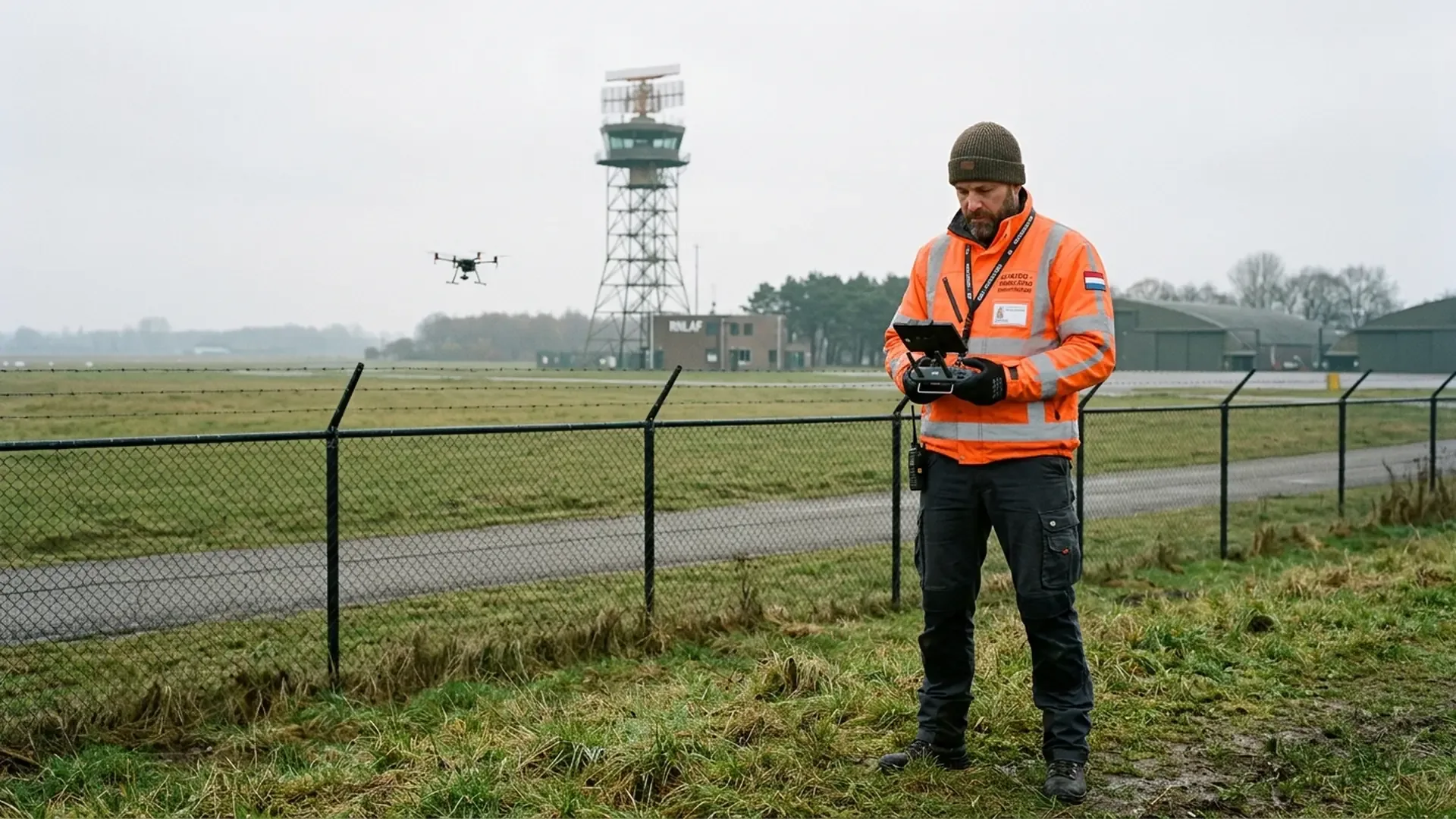
The established procedure for requesting and managing drone flights in Dutch military controlled airspace is undergoing a major structural transformation. Starting September 1, 2026, all flight requests within military Control Zones (CTRs) must be centrally submitted and managed via GoDrone. Where commercial drone operators, enterprises, and public agencies previously navigated disparate email-based workflows for each separate military base, a single standardized digital gateway is being introduced under the Flight Data NOTAM Office (FDNO) of the Ministry of Defence.
This overhaul is tailored for commercial drone operators, inspection firms, film crews, and public safety entities operating in military CTRs, Radio Mandatory Zones (RMZs), and military low-flying sectors. Centralizing pre-flight mission review enhances overall flight safety, gives air traffic managers complete real-time visibility over drone activities, and prepares the Dutch airspace for unified integration under the 1ATM modernization roadmap in partnership with Air Traffic Control the Netherlands (LVNL).
Key procedural changes starting September 1, 2026
Prior to September 1, 2026, each military air base in the Netherlands maintained individual local application protocols. Operators had to submit specific forms to individual base safety offices. Starting September 1, this fragmented approach ends and all flight plans are filed digitally through GoDrone.
It is vital to distinguish between the application review (pre-flight assessment) and the tactical flight handling (day-of-flight control):
- Application review and assessment: Mission plans submitted via GoDrone are assessed and approved or declined by Defence's Flight Data NOTAM Office (FDNO). Following the future 1ATM integration, pre-flight assessments will transition to the Flight Service Centre (FSC) and Ops Helpdesk of LVNL.
- Tactical flight handling on the day of operation: The actual operational handling of the drone flight remains, exactly as before, with the local military air traffic control tower on the air base. Even after full 1ATM integration, the local military tower retains full tactical authority. Prior to launch, remote pilots must obtain startup clearance from the tower by telephone or designated radio protocol, and immediately confirm landing upon completion.
This structure aligns with pan-European EASA regulatory developments and mirrors the latest drone regulation updates in 2026.
| Aspect | Status before September 1, 2026 | New procedure from September 1, 2026 |
|---|---|---|
| Application Channel | Varying per air base (individual email / PDF forms) | Centralized digital portal via GoDrone web and mobile app |
| Reviewing Authority | Individual local base flight safety offices | Defence Flight Data NOTAM Office (FDNO) (later LVNL FSC upon 1ATM) |
| Flight Handling (Takeoff/Landing) | Local military control tower | Local military control tower (unchanged) |
| Submission Lead Time | Variable per air base | At least 24 hours prior to flight for regular requests |
| NOTAM Requirement in Military CTRs | Frequently required depending on base | No NOTAM needed for standard flights in military CTRs |
| Geozoning | Not applicable | Not applicable to military CTRs (civil CTRs only) |
Covered military CTRs and low-flying zones
The centralized GoDrone workflow applies across all eight Dutch military Control Zones:
- EHGR: Gilze-Rijen Air Base
- EHLW: Leeuwarden Air Base
- EHVK: Volkel Air Base
- EHEH: Eindhoven Air Base (joint military/civil)
- EHWO: Woensdrecht Air Base
- EHDL: Deelen Airfield
- EHKD: De Kooy Naval Air Station
- EHDP: De Peel Air Base
Operational protocols for military low-flying sectors (GLV I-XII & LEK East/West)
Specific guidelines apply when operating within designated military low-flying sectors:
- Flights above 30 meters AGL: To operate a drone above 30 meters inside military low-flying areas, an official NOTAM request must be submitted to FDNO. FDNO sends confirmation to both the applicant and the Operations Centre of Defence Helicopter Command (OCC-DHC). OCC-DHC then contacts the operator regarding operational conditions and requests the creation of a mission plan in GoDrone to maintain crucial situational awareness for low-level helicopter sorties.
- Flights below 30 meters AGL: While a NOTAM is formally not required below 30 meters, DHC strongly appreciates operators logging these operations in GoDrone for shared visibility.
- Point of contact: Although GoDrone is utilized, LVNL and FDNO are not the contact points for low-flying mission plans. All coordination must be conducted directly with OCC-DHC.
Defence currently sets no artificial ceiling on simultaneous drone flights and remains the sole owner of local airspace procedures. State operators (police, fire services, military, and customs) remain unaffected, continuing operations under their existing priority channels.
Operational requirements, authorization and timelines
Commercial drone pilots operating in military airspace must meet strict criteria:
- Specific Category authorization: Regular drone flights in military CTRs must fall within the EASA Specific Category with valid operational authorization or LUC certification. Our cinema drone operator teams and pilots operating heavy-lift cinema drones strictly maintain these compliant standard operating procedures.
- Submission deadlines: Standard mission plans must be submitted via GoDrone at least 24 hours before flight.
- Short-notice requests (<24 hours): Submissions within 24 hours are treated as unplanned missions. Operators must contact the local military tower directly, with no guarantee that the request can be accommodated.
- GoDrone approval statuses:
- Approved: Accepted by FDNO. The local military tower still retains the authority to delay or halt operations based on dynamic military air traffic.
- Declined: Rejected, with specific grounds for refusal documented directly in GoDrone.
- Airspace activation during operations: A mission plan is required regardless of whether a CTR is actively operational at submission time. If an inactive CTR becomes active during a flight window, controllers may instruct the remote pilot to land immediately.
Standard flights in military CTRs no longer require a separate NOTAM. A NOTAM remains mandatory only for flights outside official daylight hours (UDP), operations in low-flying areas outside CTRs (>30 m), specific TRA/TSA/EHR zones, or civil airspace operations above 120 m or beyond 500 m radius requiring an ILT permit.
Step-by-step: filing a military drone flight in GoDrone
Certified remote pilots and professional drone pilots can file military missions through the following steps:
- Create an account: Register your organization and pilot profile on godrone.nl. Multi-user organizations can manage several pilots and operational roles simultaneously.
- Register fleet & operator details: Ensure your operator numbers, remote pilot licenses, and drone fleet data are up to date.
- Create mission plan: Open a new mission entry specifying the scheduled date and operating window.
- Draw flight geometry: Outline the precise operational polygon and altitude bounds on the map. You can also cross-reference our interactive Dutch drone map for surrounding airspace context.
- Complete and submit: Fill in all required parameters and submit the plan at least 24 hours prior to takeoff. GoDrone forwards the plan to FDNO.
- Track status: Monitor the review online. When marked "Approved", download your flight documentation.
- Day-of-flight tower clearance: Contact the local military tower by telephone prior to launch for startup permission, and call back immediately after landing to close the flight.
Contact directory and roadmap to 1ATM integration
The centralized workflow provides clear lines of communication for commercial operators:
- Military CTR mission plan assessment: Flight Data NOTAM Office (FDNO) of Defence.
- Military CTR tactical operations (startup & landing clearances): Local military air traffic control tower.
- Military low-flying sector coordination: Operations Centre of Defence Helicopter Command (OCC-DHC).
This unified approach delivers greater transparency and safety as Dutch airspace evolves toward full civil-military 1ATM integration.
Frequently asked questions about military drone approvals in GoDrone
When does the GoDrone military airspace application process take effect?
The transition officially goes into effect on September 1, 2026. Before that date, base-by-base procedures remain active; afterward, all military CTR flight requests are centralized through GoDrone.
Who evaluates my military drone flight application in GoDrone?
Until 1ATM integration, the Flight Data NOTAM Office (FDNO) of the Ministry of Defence reviews and approves applications. Following 1ATM integration, this responsibility shifts to LVNL's FSC and Ops Helpdesk.
Will live drone flight operations be handled by LVNL?
No. Day-of-flight tactical operations (takeoff clearance and landing notifications) will always be handled by local Defence air traffic controllers at the military air base tower, both before and after 1ATM integration.
Which military CTRs are covered by this new procedure?
The procedure applies to all eight Dutch military CTRs: Gilze-Rijen (EHGR), Leeuwarden (EHLW), Volkel (EHVK), Eindhoven (EHEH), Woensdrecht (EHWO), Deelen (EHDL), De Kooy (EHKD), and De Peel (EHDP).
How do I request a drone flight in a military low-flying area?
For flights higher than 30 meters in military low-flying areas (GLV I-XII and LEK East/West), submit a NOTAM request to FDNO. FDNO notifies OCC-DHC, which contacts the operator and requests a GoDrone mission plan. Flights under 30 meters do not strictly require a NOTAM, but logging them in GoDrone is strongly requested by DHC.
How far in advance must standard applications be submitted?
Standard mission plans must be submitted via GoDrone at least 24 hours prior to flight. Submissions within 24 hours are considered unplanned flights and require direct contact with the military tower without guaranteed approval.
Is a NOTAM still required for flying in a military CTR?
No, standard drone flights inside military CTRs no longer require a separate NOTAM. NOTAMs remain mandatory only for night flights outside UDP, low-flying routes outside CTRs (>30m), specific TRA/TSA/EHR sectors, or high-altitude/large-radius civil flights under an ILT exemption.
Does planned Geozoning apply to military CTRs?
No, mandatory geozoning rules are being implemented for civil CTRs and do not apply to military CTRs.
Does this change affect police, fire, or military drone operations?
No, state operators continue their operations unchanged through their established priority operational channels with local air traffic control.